

A listening tour is a structured opportunity for leadership (or anyone, really) to actively listen to what their team members have to say about their experience, perceptions, and needs. The goal is to foster real conversations and purposeful connections with your team. When leading a large team, this can be a daunting task because of the time requirement, but well worth it! It can reveal the unexpected or affirm your own perceptions. The benefit is gaining meaningful feedback that can be developed into action items. If you gather feedback, then make sure you are intentional and transparent about how you will turn it into action. Here are the key steps I utilized in this process.

- The Invitation: I wanted to make sure everyone understood this was simply a time to connect and get some feedback. I did not want them to spend time preparing and I wanted to keep the conversation as open as possible. I sent them each the following message:
It has been a wonderful first semester and I have enjoyed meeting each of you. I need to schedule some time to connect with each of you individually. This is an informal time for us to connect and have a conversation. There is nothing you need to prepare! I will use the following questions to guide our conversation.
- Guiding Questions: I wanted to make sure the conversations are authentic, but there was a framework to guide the discussion. This ensured that my team had processing time and knew there was nothing to prepare. As you can see, the questions were very open-ended and allowed for them to express what they needed from me as a leader.
- What is one thing you are celebrating in your team/department this year?
- What are the priorities you have for your team/department?
- What’s one thing we can do to improve the performance of our academics team
- What do you need from me?
- Scheduling Sufficient Time: I scheduled 30 minute time slots, but allowed time in my schedule for an hour in case someone needed additional time. I did not want anyone to feel rushed.
- Preparing to Be an Active Listener: I made sure I was prepared to fully engage in the conversation and listen. I made sure my cellphone was face down and I took notes on my ipad. I did not want my laptop to be perceived as a barrier or give any indication I was off task or not making consistent and frequent eye contact.
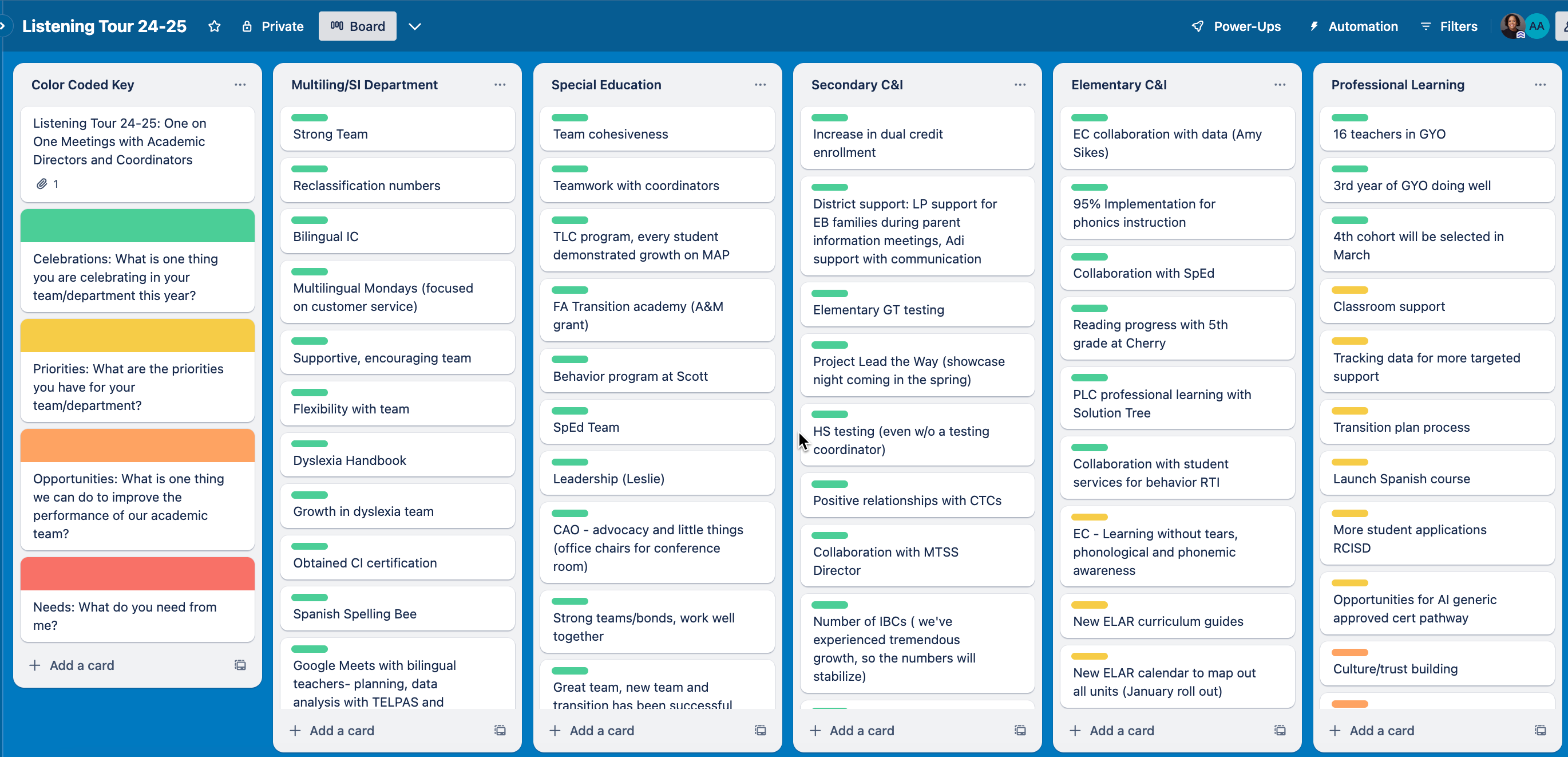
- Data Collection & Analysis: After each meeting, I organized my notes in a Trello board. My team organized in five major departments: (1) Multilingual/School Improvement/Federal Programs, (2) Special Education, (3) Secondary C&I, (4) Elementary C&I, (5) Professional Learning. I organized by group and color coded key themes in their responses. I’ve included a screenshot with three groups listed below.
- Green = celebrations (always start With good things)
- Yellow = priorities (their current area of focus)
- Orange = opportunities to improve (how we can become a better team)
- Red = needs (my personal action items)
- Sharing Observations with the Executive Team: The final step in this process to share theses outcomes with each executive director that supervises the department. It will be an additional opportunity to get their perspective.
 Lorie Cooper Squalls, Ed.D.